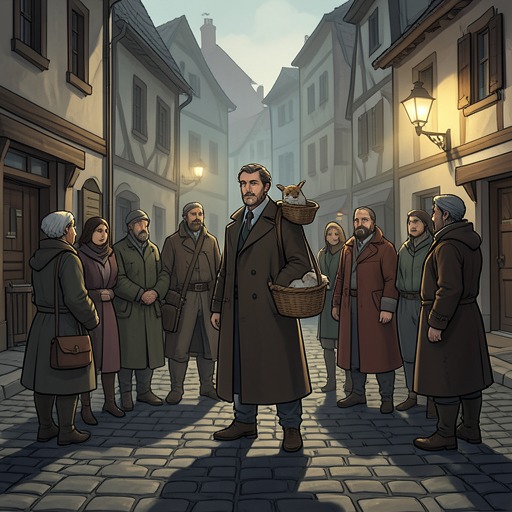
Langthorpe Falls Hotel
All Creatures Great and SmallLangthorpe Falls Hotel is an inn whose stables and coach houses have become the home of Mr. Worley’s prized Tamworth pigs. The place brings together his work as landlord and his more consuming identity as a breeder: veterinary visits are conducted amid the hotel’s livestock, while the back kitchen serves as a gathering place for conversations about pig care. Its setting near the Darrow’s descent into a ravine gives the inn a rural frame, but its distinctive character comes from the way Mr. Worley puts his animals ahead of ordinary hospitality and convention.
Setting and Premises
The hotel’s livestock occupy what were once its stables and coach houses, buildings Mr. Worley has adapted for his pigs. Because he is not a regular farmer but the inn’s landlord, his arrangement differs from the proper premises that experienced farmers considered necessary for breeding. The account presents the converted buildings not as a passing detail but as the setting for a thriving operation: the inn’s former working spaces now accommodate the animals that are central to Mr. Worley’s pride and daily concerns.
The pigs are all Tamworths. Among the porkers and animals being fattened for bacon, Mr. Worley’s six sows hold a special place: Queenie, Princess, Ruby, Marigold, Delilah, and Primrose. Their names and distinct status within the herd give the livestock a personal dimension, while the practical purpose of raising pigs remains visible in the weaners Mr. Worley takes to market. At the hotel, commercial husbandry and close attention to individual animals exist side by side.
The inn stands near a quiet loop of road, beyond which the road drops into a tree-lined ravine. The Darrow runs over a shelf of rock on its way to the lower Dale. From the road, the river and the steep cliff are not visible, though the water can be heard; on the far bank, a grassy slope draws visitors from the towns. This nearby view of visitors arriving to admire the falls contrasts with the hotel yard, where Mr. Worley’s attention is fixed on the pigs and their care.
Pig Breeding and Veterinary Work
For years, expert farmers have told Mr. Worley that breeding sows in converted buildings would not succeed. His results repeatedly contradict their judgment. His sows produce unusually large litters, care for their piglets without savaging or crushing them, and regularly raise around twelve sturdy weaners apiece by the end of eight weeks. The hotel thus becomes the setting for a quiet reversal: the supposedly unsuitable premises and inexperienced breeder prove successful by the measure that matters to the local farming community, the quality and number of pigs brought to market.
Mr. Worley’s commitment also makes the inn a frequent destination for James Herriot. He is called out for minor concerns as well as urgent ones, and his visits develop into a working relationship grounded in shared attention to animal health. In the back kitchen, with portraits of Mr. Worley’s sows and their show rosettes on the walls, the two discuss erysipelas, swine fever, brine poisoning, paratyphoid, and the relative merits of dry and wet mash. The setting gives these exchanges both a practical and a personal character: the animals under discussion are not an abstraction, but the herd whose success defines Mr. Worley’s life at the hotel.
One late-night call makes that bond concrete. At one in the morning, Mr. Worley asks Herriot to come because Marigold has farrowed and he fears she has too little milk for her hungry piglets. Herriot reaches the inn and attends to the problem; soon the milk flows, and the piglets settle into a row to feed. Their improved condition resolves the immediate worry, while the episode shows how the hotel’s livestock can summon veterinary care at any hour. For Herriot, the visit proves worthwhile despite the unexpected social obligations that accompany it.
Hospitality and the Back Kitchen
Mr. Worley’s duties as an innkeeper do not always govern his conduct. When a visitor in a large car arrives asking for tea, Mr. Worley tells him he can have it when the landlord is ready, then turns back to Herriot to discuss Queenie’s foot. Herriot recognizes the discourtesy, since serving food and drink is Mr. Worley’s livelihood, but understands that the pigs come first and that other demands feel like interruptions. The incident makes the hotel’s competing identities plain: it is a place of public service, but its owner’s priorities belong to the animals in the yard.
The back kitchen offers a different kind of hospitality. After tiring work with young cattle, Herriot sometimes retreats there in the late afternoon for a glass of ale from the cellar. The local constable, P. C. Dalloway, occasionally joins them, removing his uniform jacket and drinking a pint. His accommodating interpretation of licensing rules helps sustain this informal routine. More often, Mr. Worley and Herriot talk alone over the ale, returning to pigs and their management. Mr. Worley tells Herriot that these conversations make him as happy as the king of England. The scene links the inn’s private sociability to its public business without separating either from the subject that matters most to its landlord.
After-Hours Drinking and the Raid
The hotel’s hospitality extends beyond the hours its front door suggests. After the late-night visit for Marigold, Herriot notices conversation in the bar and finds it occupied by men drinking. Mr. Worley explains that these regulars arrive through the back after he has locked the front door. Herriot has been drawn into their company and buys a round, finding their manner efficient and their presence unexpected. The incident reveals a concealed routine within the inn’s ordinary life, sustained under P. C. Dalloway’s permissive approach to the licensing laws.
That arrangement depends on the constable’s absence. Ten minutes after Herriot leaves, while P. C. Dalloway is on his annual holiday, a relief policeman who does not share his liberal views arrives by bicycle and arrests those still drinking at the hotel. The subsequent report in the Darrowby and Houlton Times records that Gobber Newhouse and the other drinkers each receive a £2 fine. Their claim that the beer had been bought before closing time and that they had merely lingered in conversation for four hours does not persuade the magistrates. Mr. Worley is fined £15. The penalty gives the after-hours custom a consequence, but the account closes on a more immediate measure of the landlord’s fortunes: Marigold and her litter are doing well. At Langthorpe Falls Hotel, even a costly interruption to the inn’s business is weighed against the wellbeing of the pigs.